
Syd Underwood | Issue 12, Fall 2026
“I couldn’t sleep without you,” my ex would coo upon my return from even the shortest weekend trips. I never reciprocated that feeling specifically, my ability to sleep the second my head hit the pillow a lifelong source of pride. But when she suddenly left me after four years, I was now the one who couldn’t sleep without her. As we hashed out the reasons we couldn’t (and I now realize, shouldn’t) make things work, one surprising thing kept rearing its ugly head: co-dependence. She lamented how co-dependent she felt on me, to which I defensively responded: I never told you to do that.
But had I? Despite my insistence that I was too healed and mature to foster an environment for co-dependency to thrive, I had to have some sort of responsibility in the matter. There’s a certain co-dependence inherent in Lesbian relationships, and as my first real Gay relationship I thought that frenzied, almost obsessive feeling was healthy. Was real love. Not having a healthy example of love to look to and taking a somewhat sick pleasure in comparing my less dysfunctional traits to the evil internet Lesbian of the day gave me the false impression that I was relatively healthy and independent.
After weeks of crying on the bathroom floor, envying others who lost their appetite during hard times (shoutout to BED), and literally wailing to some higher power asking what I had done wrong, I finally realized not how I had done wrong in the relationship but how I had done wrong to myself. Searching for answers, trying to pinpoint the exact time things started going south, the horrifying truth finally became evident: I gave myself over to be seen.
I often overlooked my own needs and wants in service of being loved. Resentment was an invasive species, and I would abandon myself a hundred times over to annihilate it. To be radically loved wasn’t an act pulled off by being myself, but rather through a series of intricate games and tests to ensure my partner really loved me. Every time she had doubts about our longevity, I took it as a challenge rather than an invitation for reflection. I thought if I could change her mind, change myself, I could finally be what she wanted.
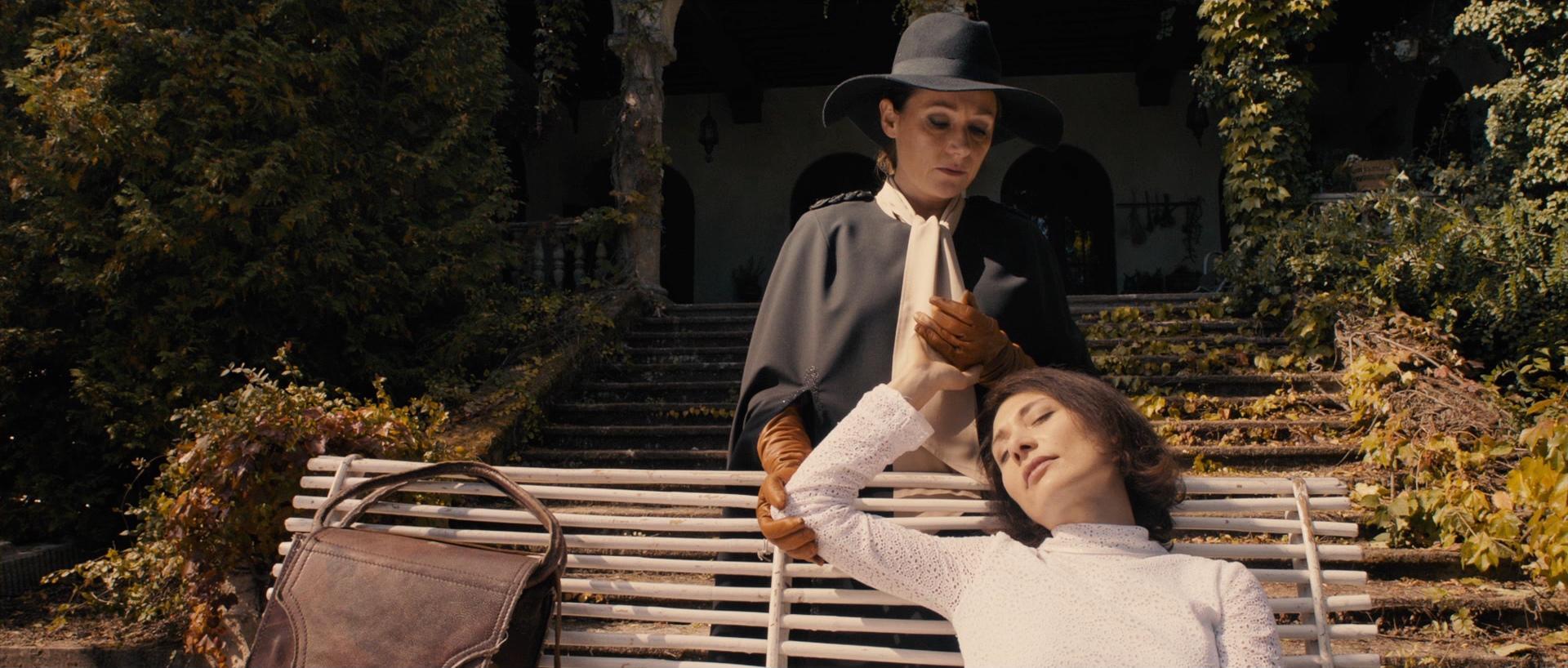
I found myself, roughly a year and a half after what will likely remain the most traumatic, grueling breakup of my entire life, watching Peter Strickland’s 2014 queer horror film The Duke of Burgundy. Having heard this film is “basically Lesbian porn” I walked into it ready for a fun, sexy romp, and was instead met with my own maladaptive behaviors mirrored to me in a way I had never seen portrayed on screen.
The film opens in an ambiguous time period where men don’t exist. A busty, red-haired dominant older woman welcomes a mousey younger woman into her home, immediately ordering the woman she apparently just met to scrub the floor, rub her feet, and hand-wash her intimates. The submissive misses a taupe-colored thong in the laundry pile, leading to an off-camera urination punishment. This is ultimately revealed to be an elaborate roleplay scenario between two long-term lovers, domme Cynthia and her sub Evelyn. Basking in their post-coital bliss, Cynthia asks for feedback from Evelyn like an overly eager actor and a director going over performance notes. She asks if her domme character was too cold, to which Evelyn happily replies, “The colder the better.” We are dropped into what appears to be a healthy Lesbian relationship, in which all parties are satisfied sexually and emotionally, but the cracks quickly become evident. Flipping the media narrative that typically portrays the domme as the one with all the control, Strickland realizes the sub actually holds the keys to power. When Evelyn is unhappy because Cynthia isn’t following the script written for her “with enough conviction” or fully becoming the character Evelyn has devised, the duo suffers.
Later, in a continuation of the same “scene” they have created, the incompetent maid returns to shine the lady of the house’s boots. Cynthia steps outside to find that Evelyn has stopped shining her tall black leather hunting boots and threatens punishment for continued bad behavior. As Cynthia returns inside, she twiddles her thumbs lest she miss her scene partner’s next cue. Evelyn similarly waits for Cynthia to return, makes loud noises with the heeled boots to get her attention, and impatiently knocks on the door before quickly getting back into character to receive her pre-ordained punishment. Like two nervous players in a middle school One Act Play performance, they quietly rely on one another to move the plot along—not knowing how to adapt if their line gets skipped or forgotten. It’s in these little moments Cynthia’s mask begins to fall, but she doesn’t dare let it slip to Evelyn, who she is determined to make happy at all costs including—but not limited to—her own self-preservation. The proceeding punishment, like much of the punishment in the film, is not shown on screen. We instead get a montage of various moths and larvae, often with a raucous score of moth squeaking, reflecting the study materials of the two of them in their day jobs as lepidopterologists.
While Cynthia certainly derives sexual pleasure from their dynamic, she primarily does whatever she needs to in hopes that her love will be requited. Evelyn is disinterested in most non-sexual intimacy and often evades any kind of physical touch. I can’t help but be reminded of how much horror I was filled with the first time I noticed my ex duck away from my needy hugs and kisses after she finally got home from work. Surprisingly, our sex life was amazing at that time right before the end (which hadn’t always been the case) but like our moth-obsessed protagonists, our physical and emotional intimacy left much to be desired. Over the course of four years, she and I had entered our own toxic cyclical pattern mirroring our protagonists: every piece of feedback or need expressed from me an attack on her, and every failure of hers to perform a rejection of my very being.
Evelyn’s avoidance reaches a new level when she requests to sleep in a trunk away from her lover, who begs her to stay in the warmth of the bed with her. Eventually, Cynthia acquiesces. In a rare moment of tenderness, Evelyn tells her, “This is all I ever dreamed about. To be owned by you. To be used by you… As long as I am yours, I remain alive.” To be used then, is to be seen. Evelyn intrinsically feels this, that to be owned means giving someone else purpose. Here on screen, I see two broken people drawn to each other like moths to a flame, and flashbacks to memories I had long suppressed bubble to the surface. Whether I want to admit it or not, I have always felt I could only be given purpose by being loved romantically. I have been both Cynthia and Evelyn. I have given lovers an exact script for how to treat me, only for that prescribed playbook to be deemed too difficult. Too much. I have begged for love and affection and to be seen. Like Cynthia, I have metamorphosed myself—rebirthed myself from a cocoon of my former self to the exact person I thought my partner wanted me to be. My ears have fine-tuned themselves to observe any slight perceived change in behavior and act accordingly—something I thought was feminine intuition but realized through nearly two years of therapy is actually maddening.
There are varying levels of co-dependence in any relationship, to be sure. We’re all familiar with the stereotypes of Lesbian couples who don’t have any other friends or hobbies outside of each other, the ones who are in bed by 9 PM and have no semblance of a social calendar. Burgundy’s protagonists take this to the nth degree. We only see them in the home or in the all-women’s university where they both work as researchers. Seemingly their only hobby is moths. When they’re not carrying out convoluted BDSM scenes, they are obsessively researching various classes of moths—carefully listening to the breeding sounds of different species, observing their behavioral patterns, and cautiously dissecting their bodies under a microscope. There’s a precision to it, a common language that they can both share where words and actions fall short. There’s concrete answers in the animal kingdom and clear hierarchies, whereas humans have to establish these roles ourselves. We’re messy, unpredictable, and contradictory. If given the option to dissect the other, to devote an entire field of study to understanding each other, would they do it? If Cynthia could understand why Evelyn desires for her partner to sleep on top of her, not in a way that fosters intimacy but in a way that requires a custom-built contraption for Evelyn to sleep under the mattress on which her domme lies, could she spend her life writing pages upon pages of research on the topic?
When Evelyn’s infidelity is discovered, Cynthia becomes the cold domineering force Evelyn has so desperately wanted—forcing Evelyn to bake her own birthday cake before eating it all herself while using the birthday girl as a human table, demeaning her physically and verbally from her own script. Confused, the sub cries out Pinastri, their established safe word, taken from the scientific name for the pine hawk-moth Sphinx pinastri. Cynthia ignores her complaints as Evelyn has done to her for the entire film, sarcastically retorting, “Oh, if we could all just say Pinastri to end our torments.” This role reversal discomforts Evelyn, for she has never heard “no” before in this dynamic. Here begins a transformation for the two of them—a beautifully phantasmagoric dream sequence in which Cynthia hesitantly opens the sleeping trunk to find only a decaying skeleton, reflecting her fear of losing her lover to her desires. Echoes of the word Pinastri flood the woods as Cynthia searches for Evelyn, finally finding her in the trunk and rescuing her from herself. The two embrace in a way that feels real for the first time. Walking down the mansion’s dark hallway, Evelyn is enveloped by moths, hundreds of the winged objects swarming her until she is no longer visible. The screeching of the Lepidopteras consuming her is deafening, like nails on a chalkboard. While BDSM is of course a healthy outlet when done centering consent-based practices, Evelyn’s desires to be held and cherished have manifested as wanting to be kept in tight spaces for safety. Finding that safety in a non-sexual way has previously been a no-go for Evelyn, but after this transformation she now gives herself over to be studied by Cynthia.
Finally feeling some catharsis and hope that these crazy kids will figure it out, Strickland says “not so fast.” Almost immediately, the scenario from the first scene begins again. The lady of the house aggressively critiques the maid’s laundry skills, but begins to stutter and choke on her words before breaking down. Evelyn comforts her, and whether this is out of genuine concern for her partner or a desire to get off remains to be seen. She begins to plead with Cynthia, saying she can change if it causes her partner this much pain. Evelyn then says the most haunting line of this entire film: “How can I resent you? I love you.”
Can resentment and love ever really be mutually exclusive? In relationships, are we convinced we’re constantly going through metamorphosis and shedding our old larvae, when really we’re just in a re-do of the process? We fix issues in our relationship to one another. Years later that issue comes up again, resentment and love duking it out. We obsess over lovers, only to forget about them months later for another. (Or, in my ex’s case, almost immediately after the end of our relationship.)
Whether or not anything actually changes with our characters is open to interpretation. After several revelations and reconciliations, the couple removes the trunk from the bedroom and returns to their sleep status quo. In the final shot of the film, Cynthia and Evelyn are back in character as the homeowner and maid. Evelyn rings the doorbell. Following her instructions from earlier to make her wait before opening the door, Cynthia stares at her reflection with an expression that’s difficult to read. Is she optimistic about how things have transformed, or is she aware as a scientist that this cycle will continue forever?
Oh, if we could all just say Pinastri to end our torments.
Syd Underwood
Syd Underwood (she/they) is a shitposter first and a writer second. Based in Austin, TX, her writing explores themes of queerness and snarky film criticism, both of which have appeared in ATX-based Hyperreal Film Journal.
IG: @sydunderwood Letterboxd: @sydellis


Leave a Reply