
Míša Štorková | Issue 6, Spring 2025


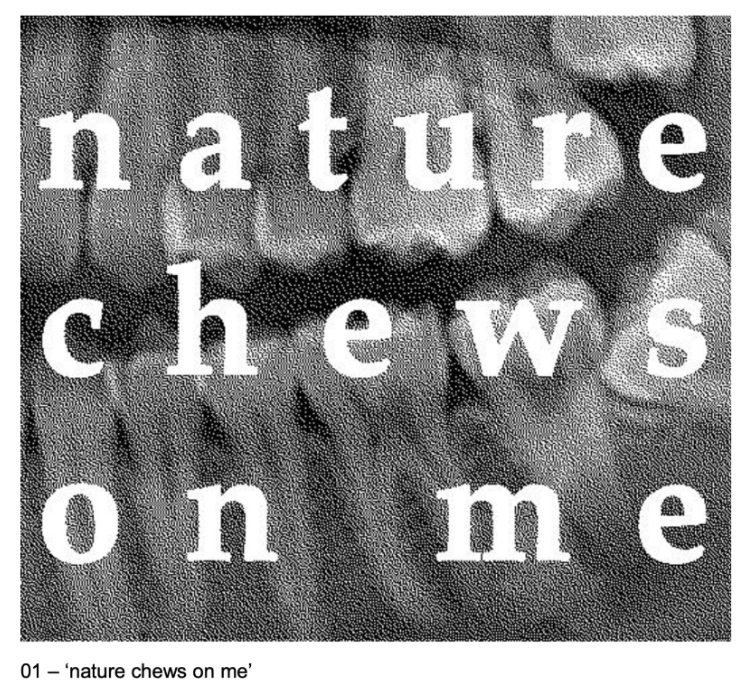
The series Parasitology is one which uses specimen imagery, EcoCrip theory, and personal reflection to examine the Disabled experience. As a physically Disabled and Trans person, I have always felt drawn to the aesthetic of a cabinet of curiosities in an empathetic sense. Historically, cabinets of curiosities have often exhibited body parts of “othered” individuals, specifically the physically Disabled, Gender- Nonconforming, and People of Colour. The basis of this work is photography, and I have worked to challenge the idea of photography as a “documentative” practice. To give my prints an explicit subjectivity, I abstract my images to give them a grimy, grunge aesthetic. Through poetic text, I challenge the typical voyeuristic gaze often projected onto “oddities.” In this way, I am the specimen, and through me, the specimen now has a voice. To make these connections, I draw on my experiences as a Disabled and Trans individual, where I have often been a subject of study and unsolved anomaly within the medical system. Overall, this series is one which utilizes imagery of scientific and collectable specimens while prompting the viewer to ruminate on the prevalence of the “othered” body in a cabinet of curiosities.
Within EcoCrip theory and Queer Ecology, parallels are drawn between “othered” individuals and the fluidity of the natural world. Similarly to how nature defies the boxes we impose on it, Queerness and Disability lie outside of normative societal boundaries. Within western cultures, nature is studied and thought to be an inanimate object in such a way which strips it of any dignity; it is dehumanized similarly to how medical speculation dehumanizes Disabled and Trans individuals. Many decomposers, scavengers, and other “gross” creatures are deemed undesirable, leading to them being pushed out of sight or even exterminated. Ironically, the reason for the prevalence of these creatures is because they thrive around humans and in urban areas; think rats, bedbugs, and pigeons. Yet, they are thought to be leaching off of humans. Disabled individuals specifically are often referred to as parasites on society, and because of this connection, I have used “disgusting” specimens within this series. The title Parasitology comes from this idea, as well as the concept within EcoCrip theory, that Disabled people are important members of society, parallel to the unloved members of ecosystems, such as parasites. The disgust and violence which “gross” specimens evoke is ultimately ironic, as they are integral members of their ecosystems, much like Trans and Disabled people. My series Parasitology uses text and specimen imagery to equate Disabled and Trans individuals such as myself to reviled, but necessary, creatures.
Míša Štorková
Míša Štorková (they/he) is an emerging artist, craftsperson, and educator studying at the University of Calgary, currently based on Treaty 7 land but originally from Czechia. Míša’s primary mediums are fibre arts and printmaking, though anything employing a hands-on mixed media approach lies within their interest. The scope of their art practice focuses primarily on the disabled experience, matrilineal relationships, and what we pass down intergenerationally – whether that be in regard to biological and/or found family. Míša strives to make works which question what we view as Fine Art, and to give voice to the ‘Othered’.



Leave a Reply